Environmental Stewardship
Doing right by people and the environment

Environmental stewardship means managing our operations and resources in ways that respect people and the environment while constantly looking for ways to improve. That includes reducing waste, striving to use fewer resources and innovating to improve how we operate.
Instead of relying on rigid checklists or isolated metrics, we use a principle-based framework to guide our decisions. Because real, lasting progress comes from empowering individuals to use sound judgment, think long term and respond to complexity in ways that respect the environment, strengthen communities and support the success of our companies. That mindset helps us adapt, improve and pursue progress that’s both responsible and real.
Strides in stewardship
Check out the data around our ongoing commitment to environmental responsibility and the strides we've made in increasing efficiencies and conserving resources through the years.
Data based on EPA TRI final 2024 data released in November of 2025 and GHG data reported to EPA May 2025 (40 CFR Part 98). Data based on non-biogenic greenhouse gas emissions.
Five environmental stewardship priorities
With more than 300 manufacturing sites across the United States – and about 100 more globally – we’re one of America’s largest manufacturers. Every day, across those sites, we strive to create more value, using fewer resources than the day before. We do it through constant improvement and innovation – both in the products we make and how we make them, and by managing our resources in a way that benefits our customers, employees, partners, community members and society.
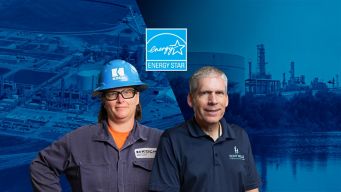
Since 2015, we’ve invested more than $3 billion, and years of hard work and innovation, in energy efficiency projects across Koch’s U.S. facilities. Across our operations, we continually work to improve energy efficiency and develop innovative technologies, which will further reduce greenhouse gas emissions. As an active partner and leader in the industry, we were recognized as ENERGY STAR® Partner of the Year in 2017, 2021, 2022, 2023 and 2024.
Essential to stewardship, and our long-term success, is the discovery of new technologies and methods to create more value for our customers while striving to use fewer resources, minimizing waste and improving the environmental performance and effectiveness of our products and processes. To do this we proactively seek knowledge from the best sources — inside and outside the company — rather than being satisfied with familiar sources.
We continually seek new ways to reduce and improve air emissions. Koch companies have reduced EPA criteria air pollutants — among those most common to industry — by 57% from 2008-2024. And in the U.S., Koch's greenhouse gas emissions are down by 11% since 2014 – that’s a reduction of more than 3.2 million metric tons of CO2e. Our companies are applying new technologies to monitor emissions leaks and correct and prevent them in real time. Our companies are also investing in improvements – one Georgia-Pacific facility has decreased its sulfur dioxide emissions by 95%.
Clean, plentiful water is vital to life – for humans and the countless plant and animal species with which we share this planet. We continually explore new opportunities to reduce water consumption and improve the quantity and quality of water discharge throughout our operations. Since 2010, Flint Hills Resources’ refineries have saved roughly 3 billion gallons of water through effluent recycling and stormwater recovery. During this same timeframe, Flint Hills refineries' water consumption intensity (net of volume withdrawn and returned to water bodies per barrel of crude oil processed) has improved by approximately 25%.
Stewardship encompasses the responsible management of our actions and the resources entrusted to our care in a manner that respects the rights of others. We make it a priority to ensure our resources are managed to create value for our constituencies and for Koch. From 2014 to 2024, the amount of production-related waste generated at our U.S. facilities is down by approximately 322 million pounds (48%). And in 2024, our reporting facilities recycled, recovered for energy or treated 89% of production-related waste – a total of 307 million pounds. And we’re nowhere near done yet.




The latest stewardship news
The following stories demonstrate the latest ways we’re putting our Stewardship Framework into action to create value in mutually beneficial ways.