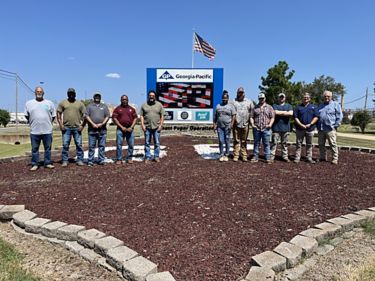
The employees at the Georgia-Pacific Crossett plant have spent the last year reviewing, developing and updating procedures focused on uncontrolled and unguarded energy.
Plant leaders at Georgia-Pacific’s pulp and paper plant in Crossett, Arkansas, recognized that they could be doing better when it came to rendering uncontrolled and unguarded energy safe for work. The procedures for this work are supposed to ensure that a machine is completely locked out from the source of energy that makes it move before someone gets close enough to be in danger, whether that’s to clear a jam or perform routine maintenance.
When a self-assessment led by the GP safety capability and supported by the site discovered that the lockout tagout procedures had succumbed to entropy and varied depending on the department, site manager Deb Coduto said it was a humbling moment.
“If this doesn’t give you a lump in your throat,” she said. “I don’t know what will.”
Immediately, she knew they needed to do something different.
At Koch, safety is our first priority. By empowering their hourly employees to discover and implement bottom-up solutions, the Crossett team made changes to their processes, procedures and training that have led to a safer working environment for everyone at the plant.
“I knew there were some gaps, I didn’t realize how much had changed,” said Mark Stanley, a master tech winder operator who’s been at the facility for almost 17 years.
To get the best results, they decided they needed to pull in team members who were closest to the work. They identified nine people who worked directly with the equipment every day and tasked them with finding out everything that needed to be done to get something to a true zero-energy state. It wasn’t going to be easy.
“Developing procedures and learning how to do it the right way is one thing,” Deb said. “But then being able to be out front, teaching, coaching, and changing the way we think about the work — that’s going to be a difficult task.”
For nearly a year, the nine-person team has been working with employees to develop, review and get new procedures approved. So far, more than 1,200 have been updated.
Mark, who is a part of the improvement team, said that as they’ve gone to the various departments to gather information, people have asked a lot of good questions.
“We tried to describe where the lockout was on a piece of equipment, and if they thought they had a better place or a better way to describe it, they would let us know,” he said.
David Parker is a skill builder in the facility’s bath tissue converting operations who has been with Georgia-Pacific for 22 years. He’s also a member of the improvement team. He said there’s a credibility the updated and new procedures have because they were developed together with the people who use the machines every day. The employees who have been through the training really understand the why behind the procedure and how that understanding is key to their safety.
“It’s about getting to zero energy when we’re working on the equipment. That’s the bottom line,” he said. “And this makes it a lot easier.”
The efforts of everyone at the facility have increased their knowledge about what it really means to get something to a zero-energy state. Deb says they’ve also reinforced their understanding of the principle of bottom-up vs. top-down and have seen just how valuable it can be when you empower employees to find and implement solutions.
“We wouldn’t have made the progress that we’ve made without that team,” she said. “Now I’ve got nine subject matter experts who are able to have those conversations about what the risk is when we don’t fully lock something out and what really can happen.”